Window tint is one of those upgrades you stop noticing once it is on, until the day the back window looks purple or a bubble appears in the middle of the driver's door. Whether you are looking at a used car with old tint or wondering whether your own is due, here is how long tint lasts, what wears it out, and what replacing it involves.
The short answer
- Good film lasts a long time. Film maker Madico says automotive films are generally designed to perform well past 10 years with proper care, and that films often outlast their warranties.
- Cheap dyed film is the one that fails early. Its dyes break down in the sun, so it fades and turns purple, and Madico notes that lower-quality films can show colour fading within months.
- Carbon and ceramic films do not turn purple, because they do not rely on dye for their colour.
- Sun, installation and care decide the rest. A car parked outside every day ages its tint faster than one kept in a garage, and ammonia cleaners and sharp objects damage film at any age.
- The warranty tells you what the maker expects. SunTek backs its Evolve ceramic film with a lifetime limited warranty against colour change, peeling, cracking, adhesive failure and delamination.
How each type of tint ages
The type of film matters more than anything else. Our guide to ceramic, carbon and dyed tint explains how each one works. Here is how they hold up over the years:
- Dyed film has the shortest life. The dye fades in the sun, the colour shifts towards purple, and the adhesive is often the next thing to go.
- Metallized film holds its colour better than dye, but the metal layer can interfere with phone and GPS signals.
- Carbon film does not fade like dyed film, because its colour comes from carbon rather than dye.
- Ceramic film has no dye to fade and no metal to block signals. It keeps its colour and clarity for the life of the film.
Why tint turns purple
Purple tint is dyed film breaking down. Madico explains that in lower-quality films the yellow dye fades faster than the blue and red, so what is left looks purple. Better films use colour-stable dyes that fade evenly and very slowly, and carbon and ceramic films avoid the problem altogether. Once film has turned purple it will not change back. The only fix is to remove it and fit new film.
Why tint bubbles and peels
Bubbles are about the adhesive, and when they appear tells you what they mean.
- In the first days or weeks, small water pockets and a slight haze are normal while the film dries. The International Window Film Association says water distortion and water haze during drying are not defects. Our tint aftercare guide explains how long drying takes in cold weather.
- Months or years later, bubbles on film that used to be clear, or bubbles that keep growing, mean the adhesive is failing. Madico notes that heat from the sun wears down film adhesives over time, and cheap film gives up first.
- Peeling at the edges usually comes from a poor installation, film that rubs on the window seal every time the window goes up and down, or windows rolled down before the film had dried.
What shortens the life of window tint
- Daily sun. Madico says a car parked in a garage keeps its tint darker for longer, while daily sun exposure speeds up fading.
- Cheap film and DIY installs. Film quality and a professional installation both matter, and Madico notes that DIY installs may not last as long.
- Ammonia cleaners. Many household glass cleaners contain ammonia, which can damage film. Use a soft microfibre cloth and an ammonia-free cleaner.
- Scratches and nicks. Seatbelt buckles, rings, keys, cargo and anything sharp that touches the inside of the glass can cut the film. Film is tough, but it is still softer than glass.
- Rolling the windows down too early. Before the film has dried, the window seal can catch the edge and lift it.
Does Ontario's climate wear tint out faster?
Not compared with hotter places. Madico notes that cooler northern climates are easier on film than hot, humid southern ones. What ages tint here is the summer sun on a car that lives outside. Winter is not a problem for film that has fully dried: tint is applied to the inside of the glass, so scraping ice off the outside never touches it.
Signs your tint needs replacing
- It has turned purple or brown, or looks blotchy.
- It is noticeably lighter than it used to be, or one window no longer matches the others.
- Bubbles have appeared on film that used to be clear, or old bubbles are spreading.
- The edges are peeling or lifting.
- The view out is hazy or distorted, especially at night or in the rain.
- It is scratched where you look through it.
- It may be too dark for the front side windows under current Ontario rules. Our Ontario tint law guide explains them.
How to check your tint properly
The International Window Film Association's inspection guidelines make a fair test: look through the glass at right angles in natural daylight, from inside the car and from about three feet outside. Small blemishes you have to hunt for are normal, because installed film is not expected to look as flawless as bare glass. A gap of 1 to 2 mm along the top edge of a roll-down window is also normal. It stops the window seal from lifting the film every time the window goes up and down.
What replacing old tint involves
New film should never go over old film. Any bubbles, purple colour or failing glue underneath would still be there, just hidden behind a second layer. Replacing tint properly takes four steps:
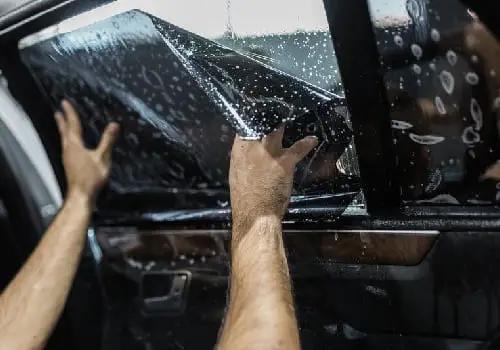
- Removing the old film. We steam it to soften the adhesive and peel it off.
- Cleaning off the glue. Old adhesive left on the glass would show through the new film, so every trace comes off.
- Taking care with the back window. The rear defroster lines are printed on the inside of the glass, right under the film, and scraping or pulling hard can break them. That is why rear windows take longer, and why removal is quoted separately.
- Fitting new film cut on a plotter to your exact make, model and year, so no blade touches your glass or seals.
If you are tempted to strip it yourself, the side windows are manageable. The back window is where DIY removal usually goes wrong.
How to make new tint last
- Choose ceramic film. There is no dye to fade and no metal to interfere with your phone.
- Have it installed indoors by a shop that backs the film and the work with a written warranty.
- Keep the windows up for three to five days, and longer in cold, grey weather.
- Clean the inside of the glass gently, with a soft microfibre cloth and an ammonia-free cleaner.
- Park in a garage or in the shade when you can.
- Keep buckles, keys and cargo away from the glass.
What our warranty covers
Every film we install carries our lifetime warranty for as long as you own the vehicle. It covers colour fading or turning purple, bubbling, peeling, delamination and our workmanship. It does not cover scratches, damage from sharp objects or ammonia cleaners, or glass that was already damaged. If the film is at fault, we replace that window at no charge.
What it costs to replace
New film for the four side windows and the back windshield starts from $150 for Nano-Ceramic, $249 for Solar Gard and $299 for SunTek Evolve, before HST. Removing old film is quoted separately, because rear windows with defroster lines take longer. Our window tint price guide has the full breakdown, or see our window tinting service and book a time at our studio on Atlantic Drive in Mississauga.
Sources
- Madico, "Does Car Window Tint Fade Over Time?"
- Madico, "How long will my car window tint last?"
- SunTek, Evolve Series ceramic window film
- International Window Film Association, automotive visual inspection guidelines for applied window film
- Our guides to tint film types, tint aftercare and Ontario tint laws