Fall is when car smells catch up with you. The windows stay shut, the heater comes on, wet leaves pile up at the base of the windshield, and the first slush is not far off. A smell you barely noticed with the windows down in July is suddenly there every morning. Here is where car odours really come from, why most quick fixes do not last, and how they are removed for good.
The short answer
- Every smell has a source. Water, smoke residue, pet hair, a spill or something rotting under a seat. Until the source is gone, the smell comes back.
- Air fresheners and odour bombs mostly mask. Consumer Reports notes that many simply cover one smell with another.
- Lasting removal is a process: find the source, vacuum, shampoo with hot water extraction, clean the hard surfaces and vents, then treat what is left.
- Ozone is a finishing step, not a fix on its own. It belongs in an empty car after a deep clean, never in a car with people or pets inside.
- Some smells are a mechanic's job. A sweet smell from the vents or water that keeps coming back points to a leak.
Find the source first
Your nose is the best tool. Sniff at the vents with the fan on, then at the carpet, the seats and the trunk. Lift the floor mats and press on the carpet underneath. Where the smell is strongest usually tells you what you are dealing with.
Musty or mildew smells
A musty smell means water. Consumer Reports traces it to a few common places: condensation sitting in the air conditioning evaporator, a clogged AC drain, blocked sunroof drains, rainwater getting past door or trunk seals, and snow tracked in on boots. If the smell is strongest at the vents, the problem is likely in the air conditioning system. If it is everywhere, check the carpet, especially in the passenger footwell. Wet carpet padding can stay damp for weeks under a mat that looks dry on top.
Smoke
Smoke is the hardest odour to remove because it does not stay in the air. It settles as a film on the glass, dash, seat fabric, carpet and headliner. Researchers at Lawrence Berkeley National Laboratory found that nicotine residue on indoor surfaces can react with a common indoor pollutant to form cancer-causing compounds, and they measured substantial levels on the surfaces inside a heavy smoker's pickup truck. They also found that opening a window while smoking does not stop the residue from building up. That is why airing out a smoker's car never quite works: the residue has to be cleaned off.
Pets
Dog hair works deep into carpet and seat fabric, and accidents soak through to the padding. Consumer Reports notes that pet odours can linger even when seat covers are used, and its writer found dog fur hiding under the floor mats.
Food, drinks and spills
Fries under the seat, a coffee in the door pocket, a milk spill on the carpet. Spilled milk is the classic one: it soaks into the padding and smells worse every warm day. Crumbs in the seat rails and cup holders add up too.
Why air fresheners and odour bombs don't fix it
Hanging fresheners, vent clips and aerosol odour bombs add a stronger scent on top of the smell. Consumer Reports notes that many odour bombs mainly mask smells, and some people find the scent irritating in its own right. When the freshener runs out, the original smell is still there, because whatever caused it is still in the carpet, the vents or the headliner.
How professional odour removal works
Lasting odour removal follows the same order every time:
- Find the source. Check the vents, carpet, padding, seats, trunk and spare tire well, and look for damp spots and water getting in.
- Remove the debris. A full vacuum under and between the seats, along the seat rails, in the trunk and in the vents.
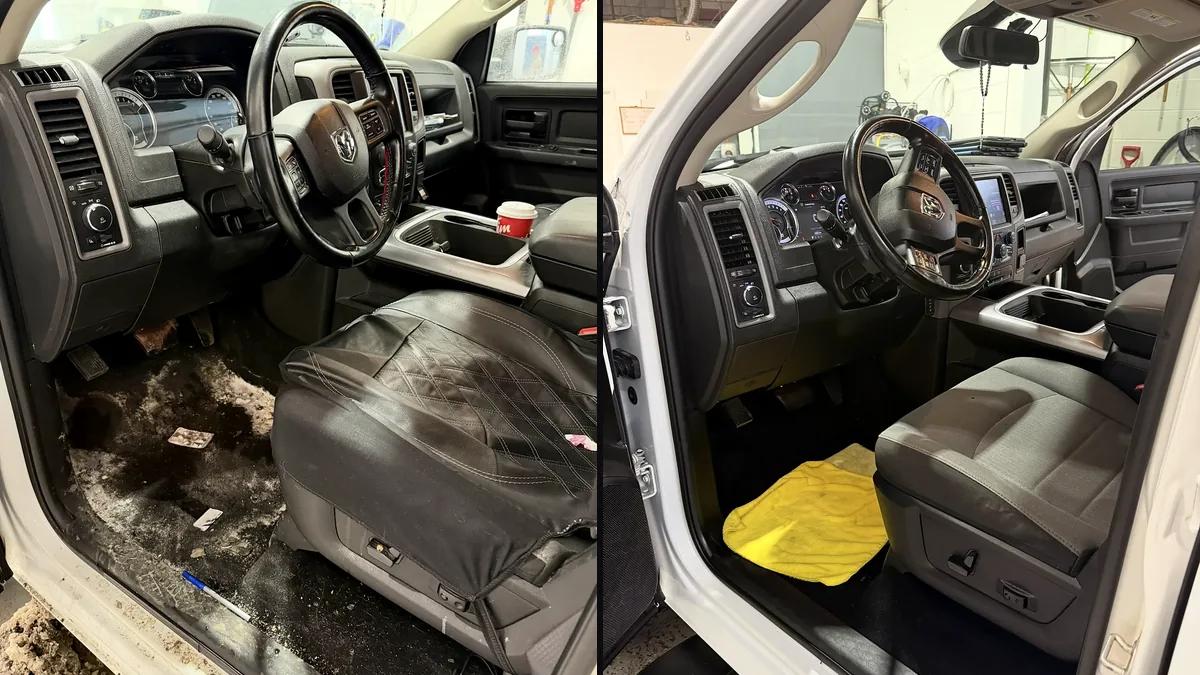
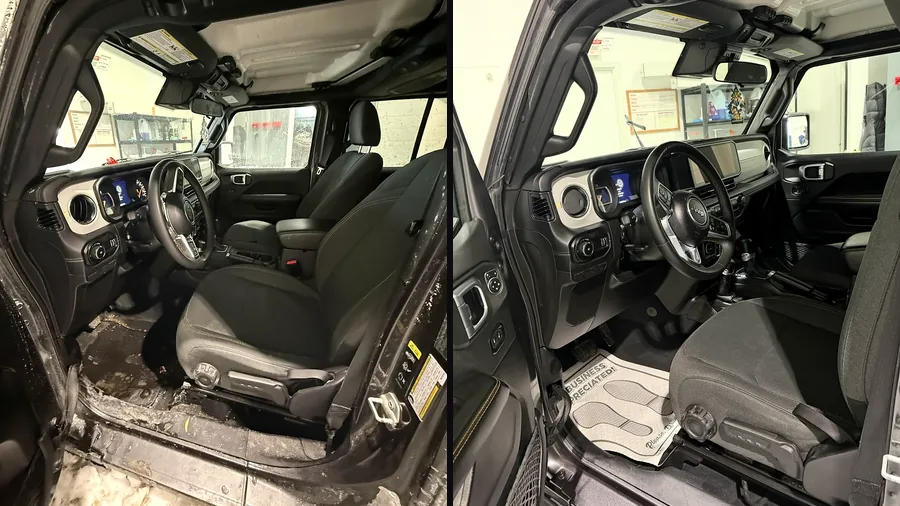
- Shampoo with hot water extraction. Carpets, floor mats and fabric seats are shampooed and the dirty water is pulled back out, taking what has soaked in with it. Everything is dried before the car goes home.
- Clean the hard surfaces. Dash, console, door panels and glass are wiped down to remove smoke film and grime. The headliner is cleaned gently, because too much moisture can loosen the glue that holds it up.
- Freshen the air system. A clogged cabin air filter holds on to odours and can even hold rotting leaves, so it is checked and replaced if needed, and the vents are treated.
- Treat what is left. For stubborn smoke and pet odours, an ozone treatment finishes the job once the source is gone.
Is ozone treatment safe?
Ozone reacts with many odour molecules, and Consumer Reports describes it as effective for lingering odours. It also needs to be used with care. Health Canada advises against using ozone generators in homes, because the ozone they produce can harm your health. The U.S. Environmental Protection Agency says high concentrations are sometimes used to treat unoccupied spaces, with conditions controlled so that no person or pet is exposed.
The EPA also explains the limits. Ozone at levels that are safe to breathe is not effective at removing many odour-causing chemicals, it does not remove particles such as dust and most allergens, and it can damage materials like rubber and fabrics. So a proper ozone treatment is done in an empty car, after a deep clean, and the car is aired out before anyone gets back in. A plug-in ozone gadget left running while you drive is not the same thing, and not something we recommend.
What you can do yourself
- Clear it out. Remove trash, check under the seats and in the door pockets, and vacuum, including under the mats.
- Baking soda on dry carpet. Consumer Reports suggests sprinkling it on dry carpet before vacuuming to help with light odours.
- Fix a musty air conditioner. With the windows open and the fan on low, spray an air conditioning disinfectant into the air intake at the base of the windshield, removing the cabin air filter first, then fit a new filter.
- Stop it coming back. Turn the AC off and let the fan run for a few minutes before you park, so the evaporator dries out.
- Keep winter water out of the carpet. Use all-weather mats in winter, and take the carpet mats out instead of stacking rubber mats on top. Our floor mats guide explains why fit matters.
- Use the right cleaners. Consumer Reports warns that bleach and hydrogen peroxide can damage upholstery, and ammonia-based cleaners can damage touchscreen coatings.
When it is a job for a mechanic
Some smells are a warning, not a cleaning problem. Consumer Reports' chief mechanic points out that bad smells can indicate a real problem that needs repair, such as a clogged air conditioning drain or a leaking heater core. A sweet smell from the vents can mean a heater core leak, and water that keeps appearing on the floor after rain means a drain or seal needs fixing before any detail will last. Burning, fuel or exhaust smells are a safety issue: have a mechanic look at them right away.
What it costs
Odour removal and ozone treatment are add-ons to any of our detail packages. The price depends on the source and how far it has soaked in: a spilled coffee is a different job from years of smoke. We look at the car first and tell you what it needs. If you are getting the car ready for winter anyway, our season-by-season detailing schedule and road salt checklist cover the rest.
Sources
- Consumer Reports, "How to Rid Your Car of Odors and Smells"
- Consumer Reports, "Tips to Get Rid of That Car Mildew Smell"
- Consumer Reports, "How to Get Rid of Musty Smell From a Car Air Conditioner"
- Lawrence Berkeley National Laboratory, third-hand smoke research (via ScienceDaily, February 2010)
- Health Canada, "Ozone"
- U.S. EPA, "Ozone Generators that are Sold as Air Cleaners"